concept note
The process of retrieving memory, an intangible phenomenon or event is a deliberate one, and the outcome is almost never a precise replication of the original experience. The artefact of remembrance,occupies new coordinates distinct from the initial event. There is a dislocation or an angular separation on viewing, which is dispersed by time and space. Looking at it from this viewfinder, introduces parallax or displacement, which inherently creates an altered perspective – a rarefied view which could be romantic, distorted, fragmented or faded.Reconstruction of memory
involves retrieval of abstract information with thought-provoking and unpredictable outcomes. As a subjective activity, it may simultaneously amalgamate newer experiences and ideologies. Revisiting memories and past experiences is accompanied by sensory associations creating multi-dimensional images, which are then expressed through the artmaking. The artist’s visualization of the past – personal memories, specific locales, sight and smells, involves the senses that paint a rich landscape of transformed, transmuted and romanticized imagery, which offers insights
into personal and collective histories.
The retrieved artefacts form distinct narratives, hosting observational parameters, sociological and cultural
archetypes, personal dogmas and critical interventions that intentionally or inadvertently introduce the separation from
the primary experience or event. Additionally, the visual artefact cannot be an impartial object, and the viewing itself
introduces preconceptions and emotive responses from the viewer.
The curatorial endeavour ‘Parallax of Visual Memories’ explores this conceptual premise through the works of nine
artists from Bangalore and examines their interpretations and visual responses, in this context.Gopinath. S renders
the sculpture ‘Twilight’ as a complex work that emerges from the contradictions of life, evolving from memories of
fears and insecurities that get allayed with the light of love and protection. He reminisces and renders the
transformative journey associated with the genesis of life, and the work symbolizes the serenity and spiritual calm of
that divine moment. The installation invites the viewer/audience to be non-passive and to become a part of the gaze
that the sculpture evokes. An open ended installation, the work acts as a stimulus to paraphrase a discourse that the
participant elects to craft. The reference to the womb and the symbol of hope connects memories of the past
with future. As an interactive and experiential piece, the artwork opens up possibilities for introspection
and conversation.
Gurudas Shenoy’s urban impressions recount chronicles constructed around cities, theirarchitecture and history,
where the enigmatic facades of structural forms narrate tales of life and living.Suggestions of emotions, personal and
collective sagas and memories lie entrenched within the walls of settlements. There is a palpable sense of underlying
mysteries and stories, made all the more conspicuous with the absence of human figures. The works allude to the
ephemeral character of man’sexistence and the transience of life itself, in contrast with the remnants and relics of
civilizations whichsurvive generations. The paintings are imprints of urban spaces as abstract archives of human
existence.Milind Nayaks’s works frame moments of exhilaration, as they recreate the past and relive
memories associated with the monsoons. The idyllic landscapes from his childhood, which came alive during
themonsoon, have remained an integral part of his persona and are depicted as evocative renderings of joyful
expressions on the canvas. The magic of the monsoon, with its exquisite interplay of light and shadows, and the misty
world as observed through sheets of rain, form enchanted moments of interlude as a consequence of colour. The
paintings recreate an oasis of sustenance where the image encapsulates transience associated with the memory of
an event.
Murali Cheeroth constructs a narrative against the backdrop of a cityscape, and employs cultural and social
archetypes, that allude to multiple markers from history which summarise the complexities of urban spaces. The work
comments on the dichotomy and conflicts inherent in the current social and political environment and on the attempts
to rewrite public memory. The visual connotations, referring to a variety of sources in the cultural sphere contain within
them an intrinsic conversation with the history of representation in visual thinking and communication. The image in its
totality and through its various associations, accentuates contemporary intricacies, to represent and contour
composite narratives, thus forming multiple layers of urban identities.
Ravikumar Kashi’s works present fragments and artefacts of memory, reconstructing narratives from the past which
impact the present. The new set of works is in response to the dystopia of our times.Disjointed and disparate objects
of varied significance, where the mundane encounters the divine in unexpected ways represent slivers of memory and
history. Traces of archaeological evidence act as visual pointers to create pieces of a puzzle, which then meld to
reconstruct segments of history and untold stories. These fragments of images recreate a visual chronicle of the past
and at the same time frame fresh narratives for the future.
Rekha Rao’s concerns with urbanization and its ecological implications paint altered landscapes that depict current
conflicts and desolation, which are in sharp contrast to episodes and images retained from memory. Yet, the gravity of
the situation is lost from the collective consciousness. The magnificence of nature is perhaps a myth, its existence
more in the mind than in reality. Essentially, the experience of observation and perception is marred by the persistence of memory, and there is a significant
dislocation between actuality and the memory of the past landscape.
Shanthamani. M’s ecological concerns give rise to a landscape, which are perhaps remnants of a city, in the aftermath
of devastation. Use of natural materials, which are ephemeral or non-renewable,allows her to highlight issues
resulting from rampant urbanization. The drawing of a landscape, a wooded forest constructed entirely of charcoal
bricks alludes to the transitory and fragile nature of the material, the memory of greenery, and warns of cataclysmic
possibilities. The splintered forest is a powerful reminder of the outcome, where charcoal could turn into ash in an
instant. The split image depicts a cityscape with high-rise buildings and its reflection in the water below; together they
are interlinked inevitably in their fate and identity. The history embedded in the material is deployed to construct the
narrative and the meaning in her works. The drawing, ‘Benda Kaluru (roots)’ acts as a metaphor which re-forms a tree
from burning the paper with camphor.S.G. Vasudev’s paintings celebrate the divine order inherent in nature and the
universe that governs the co-existence of living and celestial beings. In another work, he continues with the series
‘Rhapsody’, that is a poetic response to music. An innate memory plays out as rhythmic brushstrokes, to form
heavy textures that map a visual narrative, which is visibly lyrical. Shelving the rigidity of the form, there is anevident
progression towards the abstract. The muted colour palette allows greater interplay with the topography, while the
embellishments play out like musical notes. Animals, trees, human figures and other elements from his previous
works exist, but have evolved and morphed into figures and forms where their edges merge and amalgamate with
their surroundings.
Yusuf Arakkal’s dark canvas, heavy textures and the play of light and shadow are characteristic of hisinimitable style.
The understated colour palette and minimalist approach are possibly remnants of a frugal past, but the dark hues and
textural luminescence are deliberately crafted to engage the viewer. Hisart intrinsically evolved from his personal
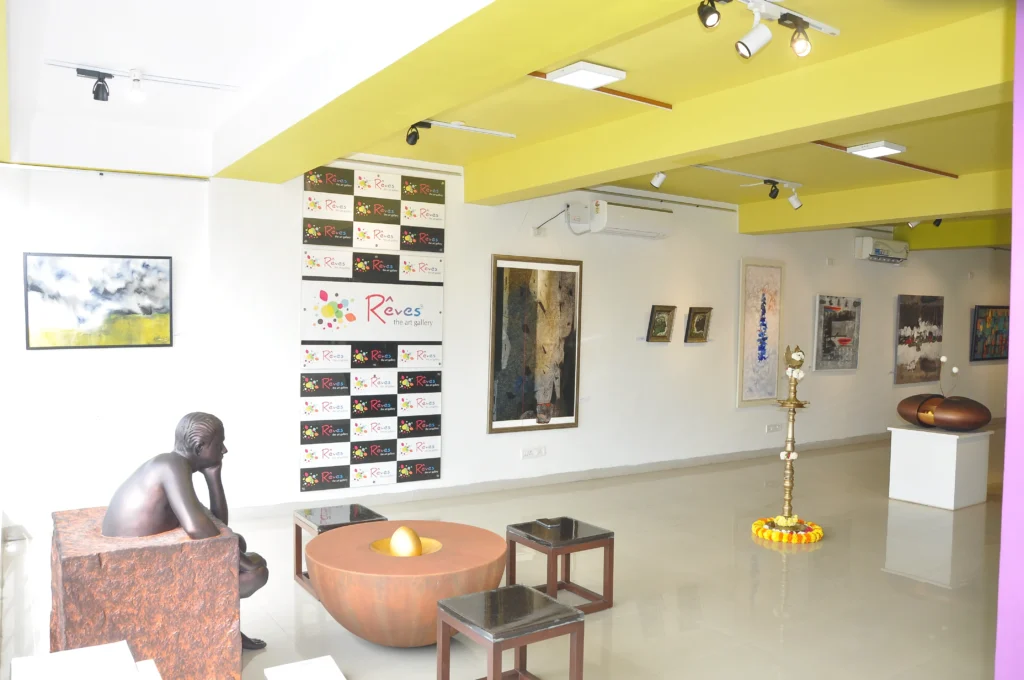
memories and search for identity. In his sculpture, he capturesthe expressiveness of a common man, caught
brooding, a solemn face weighed down by itsresponsibilities. The bronze sculpture has a raw, primal and poignant
touch to it. Heavily textured, theragged, earthy surface is captivating and a reminder of the artist’s own early life of
hardship.Memory remains a crucial device that shapes identities and narratives and profoundly impacts the present
and future. And, as observed in these artworks, remembrance as an activity can be accompanied with numerous
emotions which can be expressed as an aesthetic article, or when combined with political,
sociological and cultural statements, it has the potential to form critical interventions of high relevance to our times.